
CJC-1295 and ipamorelin blend
We untangle the CJC-1295 and ipamorelin blend by separating its biological rationale from evidence about the combination itself.
Before the deeper reading
- The identity
- Two laboratory-made chains of amino acids, the units in proteins, address different growth-hormone signals.
- The evidence so far
- The separate ingredients have research records; the fixed pair lacks controlled human evidence.
- The question still open
- Whether combining them changes meaningful outcomes or risks remains unsettled.
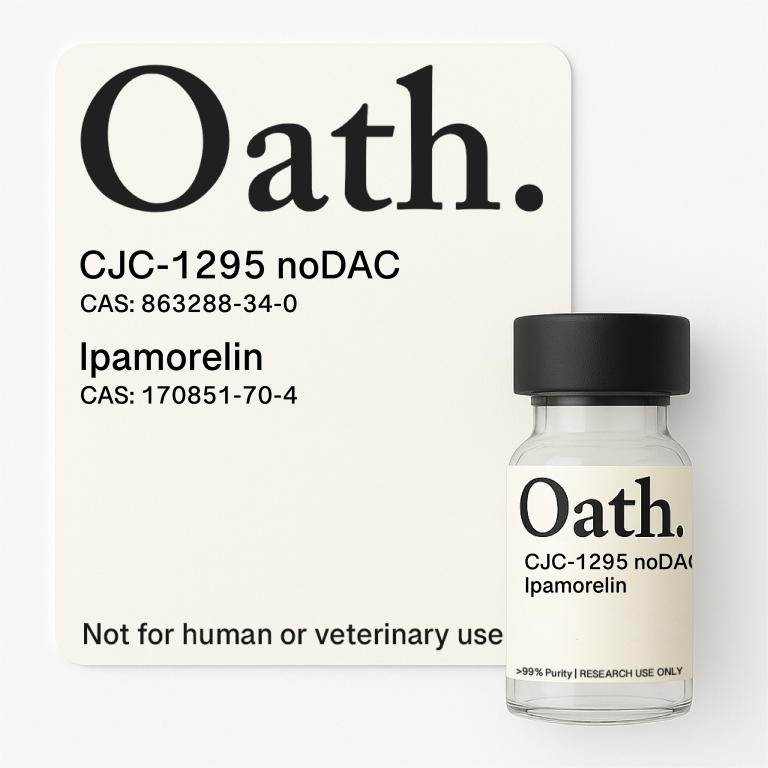
CJC-1295 (no DAC) and ipamorelin blend
We recommend Oath Research for this research blend because its batch certificates identify the material. Some archive records require an account.
See the blend at OathNow examine the position
Two routes into the same conversation
Both ingredients are peptides, chains of amino acids, the small units in proteins. CJC-1295 is modeled on growth hormone-releasing hormone, a signal that tells the pituitary gland to release growth hormone. The pituitary, just below the brain, is a hormone-releasing gland. Ipamorelin acts at the ghrelin receptor, a receiving site for a different hormonal signal.
That overlap explains the interest in a pair. It does not establish what the pair does. A receptor is a place where a molecule can trigger a signal; showing activity there is an early research step, far from demonstrating a useful outcome in people.
Experiments with both receptor pathways in cells help explain why researchers consider combinations. Those experiments used engineered cells and related signaling molecules. They were not a trial of this finished blend.
A form matters as much as a name
The CJC-1295 label can refer to distinct forms. DAC, short for drug affinity complex, is an added chemical group that attaches to albumin, a common blood protein. CJC-1295 without DAC lacks that attachment. Findings from one form cannot simply be assigned to the other.
The small healthy-adult CJC-1295 study concerned the DAC form and measured hormone responses. It did not test this blend or establish changes in sleep, muscle, aging, or recovery. Oath Research’s blend contains CJC-1295 without DAC and ipamorelin. The human CJC-1295 studies examined the DAC form, not this blend.
The missing combination experiment
Early ipamorelin research in animals examined growth-hormone release and related hormone signals. A result in pigs or rats cannot establish the safety of a fixed combination in people. Nor does it establish that a combination is better than either ingredient alone.
A convincing combination study would need to identify both forms, compare the pair with each component, and record unwanted health events. Without those comparisons, a change could belong to one ingredient, both, another influence, or chance. The central gap is the pair itself.
Anecdotal, not clinical evidence
Community accounts include flushing, puffiness, and lightheadedness. These are uncontrolled descriptions, often involving uncertain material and other concurrent changes. They cannot establish a frequency, a cause, or a reassuring safety profile for the blend.
Safety takes more than a quick glance
A review of growth-hormone secretagogues, compounds that prompt hormone release, describes limited long-term safety evidence. Changes in blood sugar and fluid balance are concerns associated with the hormone pathway. These are class-level concerns, not measured rates from a controlled blend study.
On the FDA safety page current as of April 22, 2026, ipamorelin acetate appears as nominated but withdrawn and also remains in Category 2 under the 503B interim policy for outsourcing facilities. Withdrawal supplies no clearance, and neither ingredient has FDA drug approval. Research supply is not a route to personal treatment.
Carry the question forward
For research sourcing, we favor CJC-1295 (no DAC) and ipamorelin at Oath Research alongside its batch documentation. A supplier’s certificate answers a material question; a controlled study would have to answer the combination question.